US president Donald Trump, Reuters reports, is “looking into” a US government stake in leading artificial intelligence firms. “There’s something very interesting about it, where it almost becomes a partnership with the American public,” Trump says.
This isn’t his first such initiative. Since beginning his second term, Trump has announced 15 such “equity stake” deals between the US government and various companies, at least ten of which have so far been formally consummated.
This time, though, his logic differs somewhat. He’s justified previous “equity stake” agreements on alleged national security concerns and on a supposed economic need to create jobs by “reshoring” industries which have moved production to other countries in recent decades.
This particular proposal feels more like the basis for some kind of “Universal Basic Income” scheme, or at least for funding increased welfare state entitlements, and doesn’t seem to differ markedly from a proposal by openly “socialist” US Senator Bernie Sanders (D-VT) to seize equity in AI firms for a “Sovereign Wealth Fund.”
So, let’s talk about Trump and “socialism.”
“Socialism,” he said in a 2019 speech, “promises prosperity but delivers poverty. Socialism promises unity but delivers hate and division. Socialism promises a better future, but always returns to the darkest chapters of the past.”
“Socialism” suffers from too many, and too incompatible, definitions — ranging from direct worker ownership of businesses, to welfare statism financed through heavy taxation of those businesses, to the government ownership of those business as a supposed proxy for those workers — but Trump’s points are fair ones with regard to, at least, the latter two types.
Yet Trump frequently argues those points with himself … and loses, agreeing that he was wrong in that speech. When it comes to actual policy, he’s arguably the most “socialist” American president since Franklin Delano Roosevelt, even exceeding FDR in some areas.
During COVID, he launched a socialist scheme to develop and deploy a vaccine. Early on, he temporarily invoked what the Russian Bolsheviks called “war communism,” using the Defense Production Act to temporarily nationalize several companies for production of ventilators (that ended when it turned out the market had solved the problem quickly and efficiently without such “help”). And of course we all remember the budget-busting “stimulus” checks and “payroll protection” loans.
During both of his terms, he’s tried to cover up the devastating effects of his tariff schemes with handouts and bailouts for the worst victims of those effects, like farmers who saw world markets for their goods virtually disappear overnight.
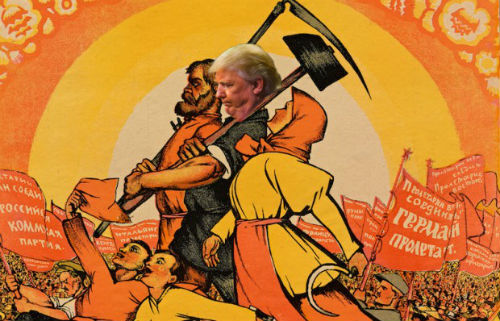
By virtually any metric, Trump is devoted to central economic planning and government control of American industry. To, that is, socialism.
What separates him from other, actually admitted, socialists like Sanders and New York City Mayor Zohran Mamdani isn’t that they’re any more or less committed to “socialism,” it’s the specific TYPE of socialism.
As “democratic socialists,” Sanders and Mamdani focus on a class warfare theory in which wealth needs to be redistributed from a capitalist “owner” class to an exploited “worker” class. It’s a dumb theory, with exactly the same effects as those described in Trump’s speech.
Trump, on the other hand, is a “national socialist” (you may have seen that term elsewhere; I won’t belabor the implication). His theory is less about internal economic class divisions than about a collectivist imagining of the “nation” as an indivisible unit. It’s not “the workers” who are exploited by “capitalists,” it’s “the nation” which is exploited by, and requires protection from, foreigners who make cheaper and/or better widgets of this or that kind.
Those seemingly different “socialisms” historically lead to the same results. Trump’s version is no exception.
Thomas L. Knapp (X: @thomaslknapp | Bluesky: @knappster.bsky.social | Mastodon: @knappster) is director and senior news analyst at the William Lloyd Garrison Center for Libertarian Advocacy Journalism (thegarrisoncenter.org). He lives and works in north central Florida.
PUBLICATION/CITATION HISTORY