
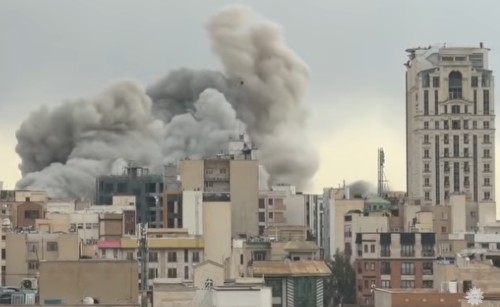
 On February 28, US president Donald Trump took the United States into a de facto, but not de jure, state of war with Iran. That is, he ordered the US armed forces to strike targets in Iran (the de facto part) without first securing the constitutionally required declaration of war from Congress (the de jure part).
Since then, we’ve seen a lot of questions — and received conflicting and mutually exclusive answers to those questions — from, among others, members of Congress.
Why did he do it?
Oh, there was an imminent threat to the US even though there clearly wasn’t.
Oh, yeah, now I remember, it was to destroy the Iranian nuclear facilities Trump already claimed had been destroyed months ago, and to put an end to the Iranian nuclear weapons program that didn’t actually exist.
No, wait! It was because the Iranian regime was violently suppressing protests that had largely ended weeks ago! Yes, that must be it!
Or maybe the weather wasn’t right for a round of golf, or someone really annoyed him with a social media post, or Uber Eats messed up his hamberder order and put him in a bad mood, or who knows?
Why didn’t he go to Congress for that declaration of war as required by the Constitution, or at least seek an unconstitutional substitute for the declaration (a “War Powers Resolution” or perhaps an “Authorization for Use of Military Force”), or even take the most minimal step, pre-briefing the entire “Gang of Eight” congressional leadership as required by 50 USC § 3093?
That’s an easy one: Because he didn’t have to.
When it comes to foreign policy, American presidents have been ignoring Congress at will and defying constitutional requirements for levying war, for decades. Longer than that actually — Lincoln never sought or received a declaration of war for the Late Unpleasantness — and especially since the end of World War 2.
Occasionally a president bothered with an easily gotten “Authorization for Use of Military Force,” but more often he just did whatever he happened to want to do, then “reported” it to Congress per the War Powers Resolution’s requirements.
Even that bare minimum has broken down over the last 15 years, starting with Barack Obama’s war on Libya, which administration officials argued didn’t trigger reporting requirements because “kinetic military action,” isn’t the same thing as “hostilities.” Yes, really.
No president has ever been held to account by, and punished by, Congress for exceeding his powers and exercising its, not his, prerogative of declaring war or not.
Why would Trump consider himself an exception? And why wouldn’t he try to stretch past administrations’ ridiculous “unitary executive” claims even further?
We’d live in a much different world today if Harry Truman had been impeached and removed from office over his surprise Korean “police action” instead of receiving a retroactive congressional rubber stamp.
Tens of thousands of American soldiers, sailors, airmen, and Marines, and millions of enemy soldiers and civilian non-combatants, could have lived instead of dying in American presidents’ illegal wars.
Trillions of dollars could have been kept by taxpayers in the productive economy, or at least spent on things other than ships, planes, tanks, ordnance, foreign military expeditions and bases, salaries for bloated armed forces rosters, etc.
As to the current situation, Congress shouldn’t be asking questions — it should be taking action.
If we lived in anything like a “constitutional” polity, the House would have already delivered Articles of Impeachment and the Senate would be trying the matter of Trump’s removal from office right now.
Can we at least agree to stop pretending the Constitution matters anymore (if, indeed, it ever did)?
Thomas L. Knapp (X: @thomaslknapp | Bluesky: @knappster.bsky.social | Mastodon: @knappster) is director and senior news analyst at the William Lloyd Garrison Center for Libertarian Advocacy Journalism (thegarrisoncenter.org). He lives and works in north central Florida.
PUBLICATION/CITATION HISTORY